

"Why are there TWO systems?" Mastering Korean Numbers!
Hi everyone! How is your Korean journey going so far?
One of the first major "roadblocks" students hit is realized that Korea doesn't just have one set of numbers—we have two.
"Wait, is it Il, I, Sam... or Hana, Dul, Set?" If you’ve ever felt confused, don't worry! This is a rite of passage for every Korean learner. Today, I’ll break it down so you can use them like a local. 😉
1. The Two Systems at a Glance
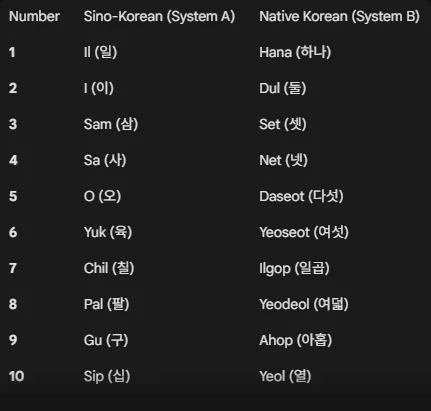
Korean uses Sino-Korean numbers (derived from Chinese characters) and Native Korean numbers. Let’s look at 1 to 10 first:
2. When do I use which?
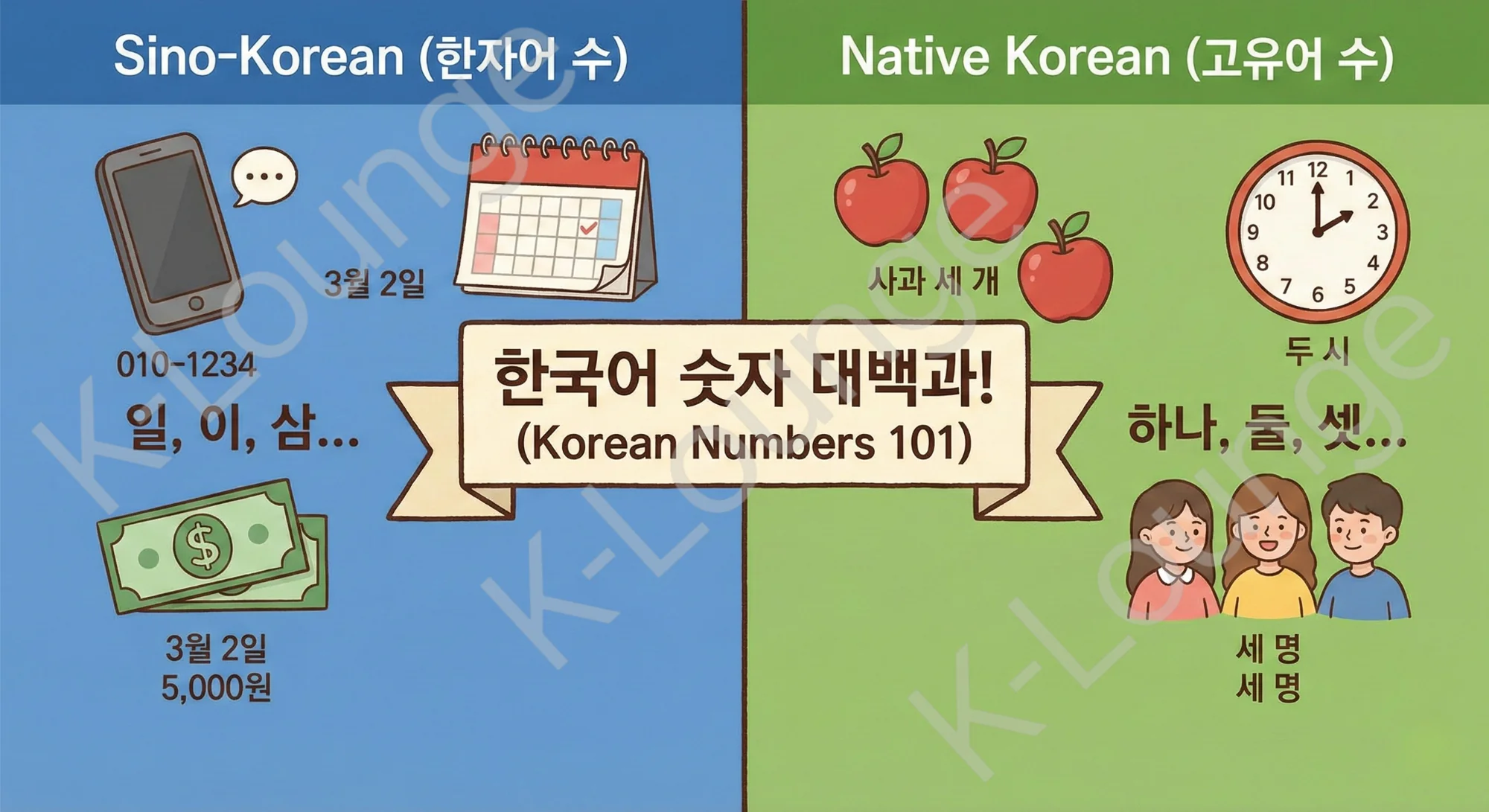
This is the golden rule! The system you choose depends entirely on what you are counting.
1️⃣ Sino-Korean Numbers: Used for "Labels" and "Measurements"
Think of these as "mathematical" numbers.
Phone Numbers: 010-1234... (Gong-il-gong, il-i-sam-sa...)
Prices (Money): 5,000 Won (O-cheon won)
Dates: March 2nd (Sam-wol, i-il)
Minutes (Time): 30 minutes (Sam-sip bun)
Floors: 5th floor (O-cheung)
2️⃣ Native Korean Numbers: Used for "Counting Items" and "Age"
Think of these as "physical" or "human" numbers.
Items: 3 apples (Sagwa se gae), 2 cups of coffee (Keopi du jan)
Age: 20 years old (Seumu sal), 30 years old (Seoreun sal)
Hours (Time): 2 o'clock (Du si)
People: 3 people (Se myeong)
💡 Pro Tip: > Telling the time is a "hybrid" system! You use Native Korean for the Hour and Sino-Korean for the Minutes.
Example: 2:30 → Du (Native) si Sam-sip (Sino) bun.
3. Watch Out! The "Shape-Shifters"
When Native Korean numbers (1, 2, 3, 4, and 20) are followed by a counter (like gae for things, myeong for people, or sal for age), they change their shape slightly:
Hana (1) → Han (e.g., Han gae)
Dul (2) → Du (e.g., Du myeong)
Set (3) → Se (e.g., Se sal)
Net (4) → Ne (e.g., Ne byeong)
Seumul (20) → Seumu (e.g., Seumu mari)
To Sum Up...
Sino-Korean: For math, money, dates, phone numbers, and minutes.
Native Korean: For counting physical things, age, and hours.
It might feel overwhelming now, but keep practicing! Try counting things you see in your room out loud. If you have any questions, drop a comment below! Happy studying! 🔥
Related Posts
초급 한국어: 스터디카페에서 자리 문의하고 시간권 결제할 때 바로 쓰는 실전 표현
스터디카페에서 빈자리 확인, 시간권 결제, 좌석 변경 요청까지 초급 학습자가 바로 써먹을 수 있는 핵심 표현과 예문을 정리했습니다.
초급 한국어: 미용실에서 예약 확인하고 원하는 스타일 설명할 때 바로 쓰는 실전 표현
예약 확인, 커트와 앞머리 요청, 길이 조절, 드라이 여부, 예상 소요 시간 확인까지 미용실에서 바로 쓰는 초급 한국어 표현을 정리했습니다.
초급 한국어: 세탁소에서 드라이클리닝 맡기고 얼룩 상담할 때 바로 쓰는 실전 표현
세탁소에서 드라이클리닝을 맡기고, 얼룩 제거 가능 여부와 찾는 날짜를 물어볼 때 바로 쓸 수 있는 초급 한국어 표현을 정리했습니다.