The Science, Philosophy, and History of the Korean Alphabet
Hello! Welcome to the fascinating world of Korean and Hangeul. Hangeul is not just a writing system; it is a special creation that embodies science, philosophy, and a king's love for his people.
To help foreign learners understand Hangeul more deeply, I have summarized everything from its origin story to its interesting scientific principles.
🌏 What are the Characteristics of the Korean Language?
Before learning Hangeul, it is helpful to understand the unique nature of the Korean language.
An Agglutinative Language: Korean changes grammatical meaning by adding various "affixes" to the end of words. For example, the verb "가다" (to go) can transform like a chameleon into "가고" (going), "가니까" (because I go), or "가요" (I go).
Word Order (SOV): While English follows an "I love you" order, Korean follows a Subject-Object-Verb order: "나(S)는 너(O)를 사랑해(V)." The verb always comes last.
Honorifics Culture: Korean has a well-developed system of honorifics where different expressions are used depending on your relationship with the person you are speaking to.
👑 1443: King Sejong’s Great Gift
In the past, Koreans used Chinese characters, but they were too complex for ordinary people to learn. King Sejong the Great felt sorry for his people and, in 1443, created Hangeul with the goal of making a writing system that "anyone could master in a single day."
🔬 Consonants: Designed by Science
Amazingly, the shapes of Hangeul consonants were modeled after the shapes of the vocal organs as they produce sound.
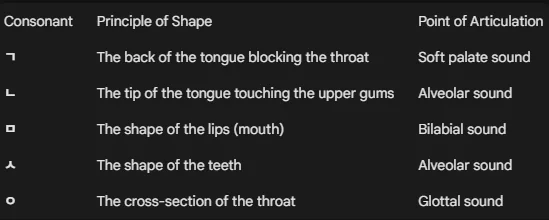
By adding strokes to these basic letters, stronger sounds like ㅋ, ㄷ, ㅌ, ㅂ, ㅍ were created. It is a remarkably systematic design.
🌌 Vowels: Infused with Philosophy
Hangeul vowels were created using three symbols representing the core of Eastern philosophy: Heaven (天), Earth (地), and Human (人).
ㆍ (Arae-a): Represents the round Heaven.
ㅡ (Eu): Represents the flat Earth.
ㅣ (I): Represents a standing Human.
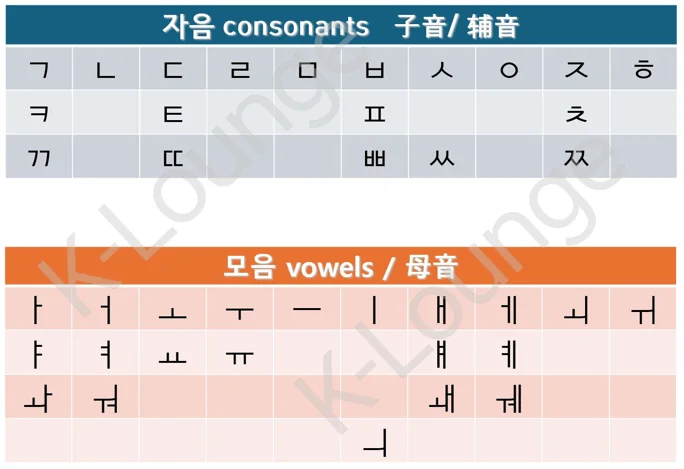
By combining these three elements, various vowels such as ㅏ, ㅑ, ㅓ, ㅕ, ㅗ, ㅛ, ㅜ, ㅠ were born. They are not just symbols; they embed the principles of the universe into the alphabet.
✨ The Excellence of Hangeul
* Easy to Learn: Once you understand the combination principles of consonants and vowels, it doesn't take long to start reading.
* Phonetic Accuracy: Since the spelling almost perfectly matches the pronunciation, you rarely have to worry about "silent letters" or irregular spellings like in English.
* Scalability: It is flexible enough to express almost any sound from languages around the world.
💡 Did you know? UNESCO established the 'King Sejong Literacy Prize' named after the creator of Hangeul to honor those who contribute to the fight against illiteracy. This is proof that the world recognizes the excellence of Hangeul!
Related Posts
초급 한국어: 미용실에서 예약 확인하고 원하는 스타일 설명할 때 바로 쓰는 실전 표현
예약 확인, 커트와 앞머리 요청, 길이 조절, 드라이 여부, 예상 소요 시간 확인까지 미용실에서 바로 쓰는 초급 한국어 표현을 정리했습니다.
초급 한국어: 세탁소에서 드라이클리닝 맡기고 얼룩 상담할 때 바로 쓰는 실전 표현
세탁소에서 드라이클리닝을 맡기고, 얼룩 제거 가능 여부와 찾는 날짜를 물어볼 때 바로 쓸 수 있는 초급 한국어 표현을 정리했습니다.
초급 한국어: 무인민원발급기에서 서류 출력하고 수수료 물어볼 때 바로 쓰는 실전 표현
주민센터나 구청의 무인민원발급기 앞에서 필요한 서류를 고르고, 영문 발급 여부와 수수료를 물어볼 때 바로 쓸 수 있는 초급 한국어 표현을 정리했습니다.